
The Short Answer
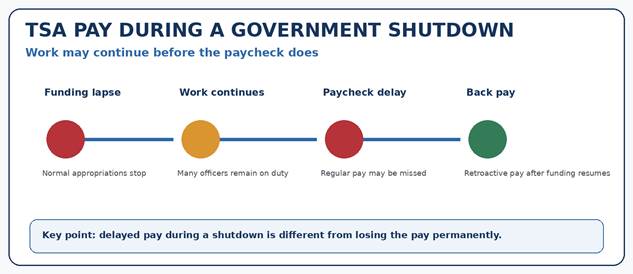
TSA officers may be required to keep working during a government shutdown even when regular paychecks are delayed. They are generally treated as excepted federal employees because airport screening is tied to the protection of life, property, and national security.
Current federal law provides retroactive pay for federal employees affected by a lapse in appropriations once the lapse ends and funding is restored. So the main risk is a temporary interruption in cash flow, not permanent loss of earned shutdown-period pay.
Why TSA Officers Keep Working During a Shutdown
A government shutdown occurs when annual appropriations expire before new funding becomes law. Agencies then separate employees into categories based on whether their work is funded another way, may legally continue, or must stop.
Airport passenger screening is considered a critical security function. TSA checkpoint officers therefore commonly remain on duty during a funding lapse while many other federal employees may be furloughed.
Applicants researching TSA Careers should understand this part of federal employment before accepting a role. A shutdown may affect the timing of pay even when the employee is still required to report for work.
What Happens to the Paycheck?
|
Stage |
What Happens |
What It Means for the Officer |
|
Before a lapse |
Normal payroll operates |
Officer is paid on the usual schedule |
|
During a shutdown |
Officer may continue working while appropriations are unavailable |
A normal paycheck may be reduced, delayed, or missed |
|
After funding resumes |
Retroactive pay is processed |
Earned shutdown-period pay is restored |
|
Payroll catch-up |
Agencies process missed regular and applicable premium pay |
Payment timing may take additional payroll processing |
Back Pay Is Required Under Current Law
The Government Employee Fair Treatment Act of 2019 changed the shutdown-pay rules for federal employees. It requires retroactive pay for employees affected by a lapse in appropriations, including employees who were furloughed and employees who performed authorized excepted work.
For excepted employees, that back pay can include basic pay and eligible overtime, premium pay, allowances, and differentials connected to the work performed, subject to the applicable pay rules.
The 2026 Shutdown Showed the Real Financial Impact
During the partial Department of Homeland Security shutdown that began in February 2026, about 50,000 TSA airport security officers were required to continue working while funding was unavailable. Reuters reported that officers received only a fraction of their usual pay early in the shutdown, and later missed full pay periods as the funding dispute continued.
The disruption was serious even though back pay was ultimately due. Officers still had rent, food, transportation, child-care, and debt payments due before retroactive payroll arrived.
Can TSA Officers Stay Home Because They Are Not Being Paid?
Not automatically. An excepted employee who is directed to work is still required to report for duty unless approved leave, illness, emergency procedures, or another authorized absence applies. Federal shutdown guidance allows agencies to place employees in absent-without-leave status for hours they were ordered to work but did not report.
If you are comparing a specific Transportation Security Officer opportunity, consider the broader employment structure as well as the posted pay rate. Federal security roles come with rules that differ from ordinary private-sector hourly jobs.
Do Health Insurance and Other Benefits Stop?
Health coverage generally continues during a shutdown-related nonpay period. OPM states that the government's contribution continues and the employee share of premiums can accumulate for collection after the employee returns to regular pay status.
Federal life insurance also generally continues during qualifying nonpay periods. Leave and benefit treatment can depend on the employee's status and the length of the shutdown, so affected workers should follow current agency and OPM instructions.
What About Overtime and Premium Pay?
TSA officers may work nights, Sundays, holidays, overtime, or other schedules that generate premium pay. When authorized work occurs during a shutdown, federal back-pay rules are designed to restore the pay the employee would have received under normal funded operations, subject to the applicable payroll rules.
Why Shutdowns Create Airport Problems Even When TSA Keeps Working
Working without a normal paycheck places financial pressure on employees. During recent shutdowns, TSA absenteeism increased and some officers resigned, which contributed to longer checkpoint waits and temporary checkpoint closures.
In March 2026, Reuters reported security waits reaching several hours at some airports as officer absences rose during the partial DHS shutdown. This shows why a shutdown can affect travelers even though TSA security operations technically remain open.
Are Private Airport Security Workers Affected the Same Way?
Not necessarily. Private security contractors are employed by private companies rather than directly by the federal government. Their pay depends on the employer's contract, funding arrangement, and payroll obligations. A federal shutdown does not automatically place them under the same delayed-pay rules as federal TSA officers.
Applicants who want to compare federal screening with contractor or airport-authority roles can review airport security jobs. The employer, benefits, pay structure, and shutdown exposure may differ.
What Prospective TSA Applicants Should Know
- TSA screening work is designed to continue during many federal funding lapses.
- A shutdown can delay current paychecks even when work continues.
- Federal law provides retroactive pay after the lapse ends.
- The financial strain can still be significant while workers wait for payroll to catch up.
- Health and other federal benefits generally continue under shutdown-specific rules.
- Airport staffing pressure may increase if absences rise during a prolonged shutdown.
External Reference
For a recent real-world example, Reuters reported on TSA officers receiving partial pay during the 2026 DHS shutdown. The report details how continued work without normal pay affected TSA employees and airport operations.
Frequently Asked Questions
Do TSA officers get paid on time during a shutdown?
Not always. If the agency lacks appropriated funding, officers may continue working while their normal paycheck is delayed.
Will TSA officers eventually receive the missed pay?
Under current federal law, employees affected by a lapse in appropriations are entitled to retroactive pay after the lapse ends.
Are TSA officers considered essential employees?
The more precise federal term is often 'excepted.' Their security duties are commonly allowed to continue during a shutdown.
Can a TSA officer refuse to work because the paycheck is delayed?
An officer who is directed to perform excepted work is expected to report unless an authorized absence applies.
Do health benefits stop during a shutdown?
Health coverage generally continues, with employee premium obligations handled under federal shutdown rules.
Do TSA officers receive overtime back pay too?
Authorized overtime and qualifying premium pay may be included in retroactive pay under applicable federal rules.
Are airport security contractors treated the same as federal TSA officers?
No. Private contractors follow their employer's payroll and contract arrangements, which differ from federal shutdown rules.
Can a shutdown make airport security lines longer?
Yes. Recent shutdowns have produced higher absences, resignations, and long checkpoint waits even though security operations remained open.
Final Takeaway
TSA officers commonly keep working during a government shutdown, but their regular paychecks may be delayed until funding is restored. Federal law requires retroactive pay for affected employees, so the core problem is timing and financial strain rather than permanent loss of earned pay. For applicants, this is an important tradeoff to understand when comparing federal TSA employment with private airport security work.